Showing posts with label sunfish. Show all posts

Thursday, January 25, 2024

Kansas State Record Redear Sunfish

redear sunfish illustration
Redear Sunfish Illustration | credit: USFWS
Great Bend resident, Jason Cavender was the last angler to set a Kansas state record for the 2023 fishing season.

Cavender landed a 1.725 pound redear sunfish while fishing at Cheyenne Bottoms Sportsman’s Club in Great Bend. 

The record-breaking sunfish measured a whopping 12 inches in girth and 12.125 inches long.

Cavender’s catch beats out the previous redear sunfish record set in 1995 by Larry Fox of Scott City. Fox caught a 1.69 pound redear from Finney Wildlife Area that measured 11.75 inches long.

The redear sunfish is the largest species of sunfish in North America. Also known as shellcracker and other nicknames, redears can attain weights of 5 pounds or more.

For more on fishing in Kansas, visit ksoutdoors.com

Friday, November 2, 2012

Bluegill Sunfish Facts

Male Bluegill Sunfish

The bluegill sunfish is one of the most colorful and popular freshwater fish species that is native to North America.

 Bluegill Sunfish Facts:

 - scientific name: Lepomis macrochirus
 - bluegill are members of the sunfish family which includes black bass, crappie, and others.
 - common names include bluegill, sunfish, bream, brim, sunny, sun perch
 - recognized as the state fish of Illinois
 - under optimum conditions, bluegill sunfish can grow to 9 inches in one year
 - average lifespan is four to six years
 - adults have a dark opercular (or ear) fin, with a dark margin
 - bluegill can hybridize with other sunfish including green sunfish, orangespotted sunfish, redear sunfish, longear sunfish, and pumpkinseeds
 - bluegills are native to eastern and central North America
 - the species has been introduced throughout North America, Europe and South Africa
 - the species is usually found in slow moving or still water with aquatic vegetation

Related Information

What do Sunfish Eat?

Thursday, July 21, 2011

How Catch Crappie and Sunfish in Heavy Vegetation


Fishing for crappie and sunfish can be rewarding for anglers with patience. During the summer season, fishing can sometimes be frustrating as these species often retreat into areas of heavy vegetation.

Fortunately, weedless lure designs allow anglers to target these fish in areas where conventional tackle is completely useless.

Black crappie, white crappie, and several species of sunfish are popular among North American anglers. These hard fighting members of the sunfish family are known for their habit of hiding among aquatic grasses and other plants.

Many of these panfish seem to have insatiable appetites and will sometimes attack anything that hits the water near grass beds or other hiding spots.

This feeding behavior can be exploited by anglers, although fishing around dense aquatic vegetation requires specialized tackle and plenty of patience

When fishing heavy cover for crappie and sunfish with artificial lures, the list of options is very short. Lure designs must be weedless, otherwise the angler will only grow frustrated as each cast yields nothing but strands of plant material..

Fly fishermen have the advantage when it comes to fishing areas where grass is abundant. Most fly anglers choose bugs or poppers which are made especially for fishing in areas of dense vegetation.

For anglers that prefer ultralight spinning tackle, small weedless spoons are one option for fishing in heavy cover.

These traditional lures are able to wobble across aquatic vegetation without fouling. Downsized plastic worms, tubes or grubs can also be rigged in weedless configurations for fishing around heavy aquatic vegetation on the water's surface.

All of these designs share a few common traits. To be effective in heavy cover, the running line must to connect to the lure at the top center (unlike jigs). Additionally, there must be some shielding of the hook and barb, so that it will not pick up vegetation as it moves thru areas of growth.

Weedless lures must also float, be neutrally buoyant, or slow sinking. Any design that sinks fast will tangle in submerged weeds and fail to produce strikes. 

Regardless of the lure chosen, the technique remains basically the same. Anglers move slowly and quietly among aquatic plants, casting towards productive areas. Lures are slowly worked across vegetation or casted directly into open patches of water.

For bait fishermen, dense vegetation also creates challenges. Some anglers deal with plants by making extremely accurate casts into nearby open areas. For the heaviest cover, a specialized crappie pole or cane pole can be useful.

These simple rods allow anglers to drop baits into even the smallest of openings. When a bite is detected, the angler must lift the fish straight out of the water before it can entangle the line in the vegetation below.

Wednesday, June 8, 2011

World Record Shellcracker?

On May 2, 2011, an Arizona angler landed what could be a world record shellcracker (redear sunfish). Robert Lawler of Lake Havasu caught the 5.55 pound, 16.75-inch redear sunfish in Arizona's Lake Havasu, using a Texas-rigged 7-inch Power Worm..

The existing Arizona state record shellcracker weighed 4 pounds 2.24 ounces and was 15.5 inches long. The record catch was made on Feb. 16, 2010 at Lake Havasu by an angler from California.

source: Arizona Game and Fish Department

Sunday, May 22, 2011

Tips for Catching Trophy Sunfish

a trophy bluegill sunfish (bream)

For panfish anglers, nothing tops a good day catching trophy sized bluegill (bream), pumpkinseed, green sunfish, shellcrackers, or other species of sunfish

This list offers a few tips for catching trophy sunfish:

* During the warm months, sunfish orient to overhanging tree limbs where insects are likely to fall into the water.

* Cast lures or live baits as close to structure as possible. If a sunfish is present, strikes usually come immediately.

* for trophy sunfish, try using slightly larger baits and hooks to discourage bites from smaller individuals.

* Most sunfish species are attracted to bright colored, flashy lures, but prefer a slower retrieve than some species.

* When targeting trophy-class sunfish with live baits, experiment with using circle hooks. These specialized hooks can be used to help curb smaller fish and avoid gut-hooking. Never snatch when bites occur with circle hooks, instead reel steadily until resistance is felt.

* When choosing bobbers, using the smallest, most streamlined bobber possible will increase strikes. Wary sunfish will often spit out a bait if too much resistance is felt.

* In clear water conditions, using flourocarbon leaders may result in more strikes from line-shy fish.

* Where currents exist, look for eddies or calm water adjacent to fast moving water.

* Experiment in deep areas by jigging vertically or letting a free-lined bait sink to the bottom.

* When sunfish are located in deep areas, try another pass as more fish may be nearby.

* Fishing kayaks can be highly effective for catching sunfish. These craft allow anglers to seek out trophy bluegill in swamps and other hard to access areas.

* Talk to fishing guides. Professional guides often know where large bluegill can be found and will share information with anglers.

Related Information

Tuesday, May 3, 2011

Best Lures for Catching Sunfish

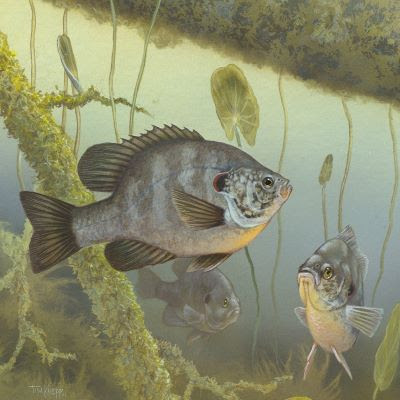
bream sunfish (bluegill)

Sunfish are favorite panfish of American anglers. Several sunfish species are found in fresh or brackfish waters of the USA. Bream (bluegills), pumpkinseeds, green sunfish, redears (shellcrackers), redbreasts, and longears are among the most commonly caught sunfish.

The list of best lures for catching sunfish is often debated, with top lures often varying widely by region. Most lists include a few basic types of fishing lures such as jigs, spinnerbaits, inline spinners, plugs, spoons, poppers, flies, and soft plastics.

The top lure for catching sunfish is usually some form of jig. These include several classic designs such as the shad dart, crappie jig, beetle spin, and others. Tiny versions of famous bass fishing lures are also popular for catching sunfish.

The following is a typical list of best lures for catching sunfish:

1/16 oz. shad dart - red and white
1/16 oz. crappie jig - red-black-white
1/16 oz. beetle spin - white with red dot
1/16 oz. plain jig head and soft plastic twister tail
1/16 oz. trout bomb head - various soft plastic bodies or tipped with nightcrawler
1/16 oz. Rapala floating minnow - silver w/black back
Strike King 3/32 oz. bitzy minnow - gizzard shad pattern
1/4 oz. Daredevle spoon - red and white
.13 oz. Hopkins lure - metal hammered finish

This list does not include ice fishing for fly fishing lures. Each of those specialties have their own sets of top performing sunfish lures.

These same lures are usually good choices for other members of the bass and sunfish family such as rock bass, warmouth, black crappie, white crappie, fliers and others.

Most of these lures are also excellent choices for catching perch and other panfish.

Related Information


Tuesday, February 22, 2011

Spinnerbait Techniques For Catching Panfish

Spinnerbaits are excellent lures for catching bass, crappie, bream, yellow perch and other freshwater fish, especially during cool weather when fish are sluggish.

Most panfish spinnerbaits use a special metal arm and jig combination. One end of the arm is equipped with a swivel and a silver or gold blade. The other end of the arm is equipped with a snap for connecting to the jig.

These simple designs have several advantages:

 - Their modular construction allows anglers to easily change soft plastic lure bodies or jig heads.

 - Most models can be purchased with or without a jig.

 - Simple spinnerbaits catch a wide range of species, including largemouth bass, black crappie, bream sunfish, rock bass, yellow perch, and chain pickerel.

 - Anglers can choose from a variety of soft plastic bodies, marabou jigs or add bait strips.

 - Due to their design, spinnerbaits are less likely to get hung up on limbs or other underwater obstructions. 

 - Spinnerbaits can be worked very slowly, allowing sluggish fish time to react.

- Pulsating spinner blades create pressure waves as well as bright flashes which attract fish in murky water.