Showing posts with label freshwater fish. Show all posts

Thursday, May 30, 2024

Common Carp Length - Weight

Common Carp
Common Carp | Credit: USGS

Common carp, a species originally native to Asia and Eastern Europe, have been introduced to environments worldwide.

They are known for their adaptability and size variability, which can be influenced by factors such as habitat, diet, and age.

The common carp's ability to reach substantial sizes is one of the reasons it is prized by anglers and considered a challenging catch.

Typically, a common carp that measures 15 inches in length may weigh around 2 pounds. As they grow, the weight-to-length ratio increases. A 16-inch carp might average closer to 2.5 pounds. This incremental growth continues, with a 17-inch carp possibly weighing around 3 pounds, and an 18-inch carp around 3.5 pounds.

The pattern of growth tends to follow this trajectory, with each inch in length adding roughly half a pound to the carp's weight. By the time a carp reaches 24 inches, it could weigh approximately 6.5 pounds.

Moving towards the upper end of the scale, a 30-inch carp often tips the scales at about 10 pounds. As the carp grows larger, the weight gain per inch can become more variable.

A 35-inch carp might weigh in the region of 15 to 25 pounds, and a 40-inch carp could weigh 25-40 pounds or more, depending on the conditions it has lived in.

It's important to note that these figures are averages and individual weights can vary significantly. 

Notable Carp Catches - Length and Weight

While bowfishing in 2014, Adam Faatz of Hawthorne, NJ, broke the New Jersey state record for common carp with a 45 lb. 6 oz. specimen with a length of 42 inches.

On June 9, 2013, bowfisherman Patrick Johnson took a new Ohio state record carp in Lake Erie. The massive carp weighed 53.65 pounds and measured 45 inches in length.

In 2022, Ayden Minick caught and released a new West Virginia state record common carp caught from Summersville Lake. The record-setting carp weighed 45.2 pounds and was 41.2 inches long. 

In 2012, bowfisherman Zack Seitz reeled in a 59-pound common carp measuring 46 inches long, breaking the Wisconsin state alternate method record.

Related Information

Carp Fishing in North America


Thursday, January 25, 2024

Kansas State Record Redear Sunfish

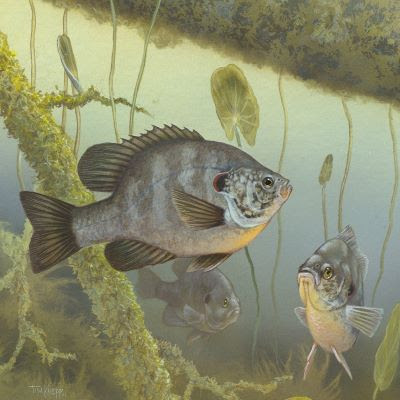
redear sunfish illustration
Redear Sunfish Illustration | credit: USFWS
Great Bend resident, Jason Cavender was the last angler to set a Kansas state record for the 2023 fishing season.

Cavender landed a 1.725 pound redear sunfish while fishing at Cheyenne Bottoms Sportsman’s Club in Great Bend. 

The record-breaking sunfish measured a whopping 12 inches in girth and 12.125 inches long.

Cavender’s catch beats out the previous redear sunfish record set in 1995 by Larry Fox of Scott City. Fox caught a 1.69 pound redear from Finney Wildlife Area that measured 11.75 inches long.

The redear sunfish is the largest species of sunfish in North America. Also known as shellcracker and other nicknames, redears can attain weights of 5 pounds or more.

For more on fishing in Kansas, visit ksoutdoors.com

Sunday, January 8, 2012

Largemouth Bass vs. Smallmouth Bass

Two types of black bass are often caught by North American anglers. Among the most popular freshwater fish in North America, the largemouth bass and smallmouth bass look similar but have considerably different lifestyles.

Largemouth Bass Facts

Largemouth Bass
Largemouth Bass

Adult largemouth weigh up to 20 pounds and can live up to 15 years.

The native range of largemouth bass is the largest of all black bass species. They have been widely introduced beyond historical limits and are now found in most of the USA.

Largemouth bass are most abundant in shallow, weedy lakes. They are also found in farm ponds, mill ponds, and other small bodies of water.

Largemouth also live in tidal rivers and creeks and can tolerate brackish water more than some other freshwater species.

Largemouth bass virus (LMBV) is a serious problem in some lakes and reservoirs. Outbreaks of the disease in an impoundment often reduce bass populations significantly.

Other names for the species include large mouth, bucket mouth, green bass, black bass, river bass.

Smallmouth Bass Facts

Smallmouth Bass
Smallmouth Bass

Smallmouth bass weigh as much as 6 pounds. They have been known to live as long as 15 years, although fish over 7 years of age are considered uncommon.

Smallmouth bass are found in clear, cool lakes, rivers, and streams.  They prefer large lakes over 100 acres in size and deeper than 30 feet rather than shallow ponds.

Smallmouth bass feed primarily on crayfish and small fish. As adults grow larger, crayfish and small fish make up an even larger part of their diet.

Bass in lakes tend to be more abundant and faster growing than those living in rivers and streams. Individuals in warmer, southern reservoirs tend to grow faster, but have shorter lifespans than fish from cooler lakes and streams.

In flowing streams, smallmouth tend to be found in deep pools and around rocks. In some streams, adults may occupy a specific pool for the entire warm season.

Smallmouth bass have been introduced into several northern lakes outside their historical range. In northern lakes, the introduction of non-native smallmouth bass has had negative impacts on native species including, brook trout, rainbow trout, Atlantic salmon, and other fish.

Members of this species are known to seek shade in warm weather and also move into deeper, cooler water during summer.

In some areas, smallmouth bass populations are threatened by invasive Alabama bass.