Sunday, December 24, 2023

Atlantic Sturgeon Facts


Atlantic Sturgeon
Anglers sometimes encounter strange creatures in the rivers, streams, and backwaters of the Atlantic Coast. From coastal bays to shallow streams, Atlantic sturgeon are rarely seen but sometimes present.

Sturgeon Facts


Fossil records of sturgeon date back to the Cretaceous period. There are 25 different species of sturgeon worldwide.

Nine species of sturgeon are listed as either threatened or endangered under the Endangered Species Act. They are considered one of the world’s most endangered groups of species.

There are five distinct population segments of Atlantic sturgeon in the United States. Four of these segments are considered endangered. The other is considered threatened.

Adult Atlantic sturgeon typically reach lengths of six to eight feet and weigh 200 pounds or more. In Canada, individuals up to 14 feet long and 800 pounds have been recorded.

The Atlantic sturgeon can be distinguished from other sturgeon species by its long, narrow snout, relatively small mouth, and four barbels. Adults are olive- green to blue-black above, with white undersides.

Atlantic sturgeon can live 60 years or more. Sturgeons have declined due to overfishing, water pollution, vessel strikes, habitat loss, and other factors.

Atlantic sturgeon are listed as endangered or threatened by the U.S. Fish and Wildlife Service in multiple coastal estuaries.

Atlantic Sturgeon restoration programs have been launched, although much work remains.

Atlantic sturgeon have anadromous lifestyles. Adult sturgeon migrate up rivers to spawn in areas with hard bottoms.

After hatching, young sturgeon live in freshwater rivers for several years. Eventually, juvenile fish migrate out to sea.

Researchers are learning more about Atlantic sturgeon by tracking their movements using acoustic telemetry. Telemetry uses sound to relay information across open space. Scientists surgically insert special sound-emitting tags.

Thursday, August 18, 2022

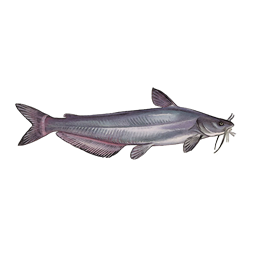
Virginia State Record Blue Catfish (Archery)

blue catfish

Virginia Department of Wildlife Resources recently announced that the Virginia state record for archery blue catfish has been broken.

Jason Emmel from Louisa arrowed a 66-pound, 5-ounce blue catfish from the Pamunkey River for the new state record.

The fish measured 3 feet, 6 inches and had a girth of 35 inches. After biologist verification and review by the State Record Committee, Emmel’s catch was certified and is recognized as the current Virginia Archery State Record Blue Catfish.

The previous record was held by William Bates, Jr. with a 62-pound, 4-ounce blue catfish captured in 2021 from Occoquan Bay in Fairfax.

In Virginia, bowfishing is one of several forms of alternative fishing methods that are increasing in popularity.

Tuesday, June 14, 2022

North Dakota State Record Buffalo (Bowfishing)

bigmouth buffalo fish
Buffalo Fish | credit: USFWS

In May 2022, a bow fisherman from Bismarck set a new North Dakota bow/spear state record for bigmouth buffalo.

Mitch Estabrook took a 60-pound, 8 ounce buffalo by bow from Heart Butte Reservoir.

Estabrook's fish broke the previous record by 3 pounds, taken at Heart Butte Reservoir in 2017.

Buffalo are a native fish sometimes confused with nonnative and invasive common carp.

North Dakota Game and Fish Department records indicate that Estabrook’s fish is the largest weighed in the state that was not a paddlefish or pallid sturgeon.

Buffalo fish are identified by their heavyset bodies, large scales, and blue-green to bronze coloration.

They have relatively large, forward-opening mouth for a member of the sucker family.

Bigmouth buffalo are the largest member of the sucker family.

Buffalo are commonly mistaken for, but not related to common carp.

The species is not commonly caught by anglers, but are a primary target for those who bow fish.

Recent studies have shown bigmouth buffalo can live to very old ages, with some fish over 100 years old recently documented in neighboring Minnesota.

source: North Dakota Game and Fish Department

Saturday, June 11, 2022

New York State Record Channel Catfish

channel catfish
Channel Catfish
The New York State Department of Environmental Conservation (DEC) recently announced that on May 8, 2022, Bailey Williams of Watertown set a new State record for channel catfish.

Williams landed the 35-pound, 12-ounce channel catfish from the Black River in Jefferson County using cut bait while bottom fishing.

Williams' record-breaking catch surpassed the previous State record catfish, caught from Lake Ontario in 2017, by 9 ounces.

Channel catfish are the largest catfish that live in New York. They feed primarily on the bottom and are most often caught using live bait such as worms or baitfish. They can also be caught with artificial lures, especially soft plastics worked along channel edges or other bottom structure. 

Williams submitted details of his winning catch as part of DEC's Angler Achievement Awards Program, which tracks State-record fish.

Through this program, anglers can enter freshwater fish that meet specific qualifying criteria and receive official recognition of their catch and an embroidered patch commemorating their achievement.

The three Angler Achievement Awards categories are: Catch and Release, Annual Award, and State Record.

A photo of the new state record channel catfish can be found on the New York State Freshwater Fishing Records page of DEC's website. For more information about the Angler Achievement Awards Program, visit dec.ny.gov.

The Black River originates in the western Adirondacks and follows the divide between the Tug Hill Plateau and the Adirondack foothills to Carthage. The lower section of the river follows a wide curve to Watertown and then a gorge leading to Lake Ontario.

The stretch of the river around Watertown contains a variety of fish species and habitats ranging from riffles and pools to weedy backwaters. The lower Black River is popular with kayakers and other small craft enthusiasts.

Saturday, June 4, 2022

Northern Snakehead Facts


Northern Snakehead
Northern Snakehead

The northern snakehead is an invasive species of fish that has become established in parts of the USA. Once introduced into a watershed, these aggressive predators can spread quickly.

Northern Snakehead Facts

  • The northern snakehead is Native to China, Russia, and Korea.
  • Snakeheads often multiply quickly and grow rapidly in new environments.
  • Hotspots in the USA include the Chesapeake Bay, New York, Pennsylvania, and Arkansas.
  • Northern snakeheads often reach lengths of 30 inches or more and weigh in excess of 10 pounds.
  • Northern snakeheads have 2 rows of sharp teeth; they can inflict painful wounds.
  • Snakeheads have a coating of thick, foul-smelling slime.
  • Northern snakeheads breed during the summer and may reproduce multiple times.
  • Eggs are laid in a nest made of vegetation.
  • Spawning pairs aggressively defend eggs and young.
  • Adult snakeheads eat mainly minnows and other small fish.
  • Large individuals also prey on adult fish and other wildlife. 
  • The explosion of northern snakehead populations has led to entirely new sport fisheries.
  • In some areas, snakeheads are taken by bowfishing or other alternative fishing methods.

Related Information

Pennsylvania Northern Snakeheads